


Have you ever relaxed your grip on the steering wheel for just a moment and felt your car quietly wander to the right? Maybe the steering wheel sits crooked, the tires make a little “squeak-squeak” around corners, or your vehicle feels restless on I-4.
That uneasy feeling deserves attention.
A car should track straight and feel predictable. When it starts tugging, wandering, or chewing through tire tread, it may be asking for a wheel alignment in Lakeland, FL. At Autosauce, we help local drivers understand what their vehicles are trying to say before a small handling issue becomes an expensive tire or suspension problem.
What is a wheel alignment?
A wheel alignment adjusts the angles of your wheels so they sit correctly in relation to the road, the vehicle, and one another. Think of it like adjusting the legs on a table: when everything is positioned properly, the table sits steady. When one leg is off, the whole thing rocks.
Technicians commonly check three alignment angles:
- Camber: The inward or outward tilt of the wheel when viewed from the front.
- Caster: The angle of the steering pivot, which helps the vehicle track straight and return the wheel after a turn.
- Toe: Whether the fronts of the tires point slightly inward or outward when viewed from above.
These angles work together. If one is outside the manufacturer’s specifications, your car may pull, your tires may wear unevenly, and your steering may feel less stable.
5 signs your car may need an alignment in Lakeland
1. Your car pulls to the right on a straight road
This is the classic warning sign.
If your car consistently drifts right on a relatively flat, straight road while you’re holding the steering wheel straight, the alignment should be checked. The same applies if it pulls left. A slight drift can sometimes be caused by the natural slope, or “crown,” built into a road to help rainwater drain. But a strong or sudden pull is not something to ignore.
Before assuming alignment is the cause, our team may also check:
- Tire pressure differences
- Uneven tire wear
- A sticking brake caliper
- Worn steering or suspension parts
- A damaged tire
- Previous curb or pothole impact
That is why a professional inspection matters. Alignment is not a guess-and-tighten service. It is a measurement process.
For drivers in Lakeland, potholes and rough pavement around local streets, shopping areas, highway ramps, and the I-4 corridor can deliver the kind of sharp impact that shifts suspension components or changes wheel angles. Your car may not make a dramatic “bang” when it happens. Sometimes it simply begins acting different afterward.
2. The steering wheel is crooked when you drive straight
When your vehicle is traveling straight, the steering wheel should generally sit near center. If it is noticeably tilted while the car tracks forward, the steering and alignment angles may not be balanced correctly.
Your vehicle is essentially trying to tell you, “I’m going straight, but my steering wheel is compensating for something.”
A crooked wheel can develop after:
- Hitting a pothole
- Bumping a curb
- Replacing suspension or steering components
- Installing new tires
- Driving for a long time with worn parts
An off-center steering wheel may seem like a minor annoyance, but it can make it harder to judge whether the car is truly tracking straight. On a busy road or during a sudden maneuver, predictable steering is important.
At Autosauce, our certified technicians can inspect the steering and suspension before performing an alignment. Our goal is to correct the cause, not simply make the symptoms disappear for a few miles.
3. Your tires are wearing unevenly
Tires are supposed to wear evenly across the tread. If one shoulder is disappearing faster than the rest, your car may be placing too much pressure on that edge.
Look for these patterns:
- Inside-edge wear: Often associated with excessive negative camber or other suspension concerns.
- Outside-edge wear: May indicate positive camber, aggressive cornering, or underinflation.
- Feathering: Tread blocks feel smooth in one direction and sharp in the other, often pointing toward a toe problem.
- One tire wearing faster than its partner: May suggest alignment, tire pressure, suspension, or brake issues.
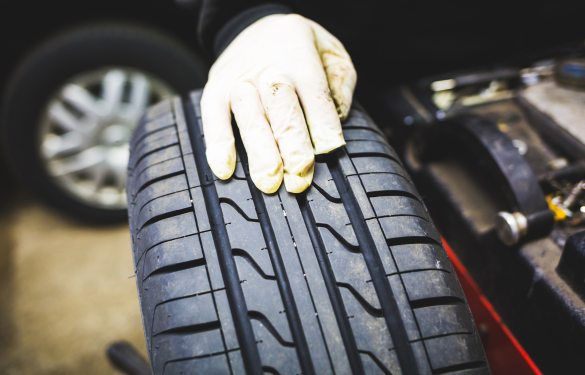
Run your hand carefully across the tread and compare the front tires. If one feels rough, sawtoothed, or noticeably different, schedule an inspection rather than waiting for the wear bars to appear.
Florida’s frequent rain makes good tire contact especially important. Humid weather itself does not knock your alignment out, but wet roads leave less room for mistakes when a vehicle already has uneven tread or vague steering. A properly aligned vehicle helps your tires meet the road more consistently.
If your tires are too worn to save, Autosauce also offers tire sales and installation. A new set of tires and a correct alignment often work best together.
4. Your tires squeal during ordinary turns
A little tire noise during spirited driving is one thing. Hearing “eeeek” during a normal, low-speed turn into a parking space is another.
Misalignment can cause a tire to scrub sideways instead of rolling smoothly through a turn. This is especially common when toe angles are out of specification. The tire is fighting the direction it is being asked to travel, creating friction, noise, and accelerated wear.
Pay attention if the squealing happens when you:
- Turn into a driveway
- Exit a parking space
- Make a normal intersection turn
- Take a slow ramp
- Maneuver in a parking garage
Squealing alone does not prove an alignment problem. Tire condition, pressure, road surface, and suspension wear can also contribute. But when squealing appears alongside pulling or edge wear, it is a strong reason to have the vehicle checked.
5. The steering wheel vibrates or the car wanders
A shaking steering wheel can come from several issues, including an imbalanced tire or a bent wheel. However, alignment and suspension problems can also make the vehicle feel nervous, loose, or difficult to keep centered.
You may notice that your car:
- Requires constant steering corrections
- Wanders in its lane
- Feels loose over uneven pavement
- Responds inconsistently when you turn
- Shakes or vibrates at certain speeds
- Feels like it is “dog-tracking,” with the rear seeming out of line with the front
A car that wanders is not just irritating. It can increase driver fatigue, particularly during longer trips on I-4. If you are constantly nudging the wheel: tap, tap, tap: your vehicle deserves a proper diagnostic.
What happens during an alignment inspection?
A professional wheel alignment service begins with an inspection, not a shortcut.
Our team looks at the tires, steering components, suspension parts, ride height, and any signs of impact damage. We then use alignment equipment to measure the wheel angles against the vehicle manufacturer’s specifications. You can think of the equipment as a highly precise level and measuring tape for your chassis: only far more advanced.
If the measurements are out of range, the technician makes the appropriate adjustments where possible. If a worn tie rod, ball joint, control arm, bushing, or other component is preventing a proper adjustment, we explain that before recommending repairs.
This distinction is important. An alignment cannot repair a broken suspension part. It can only set the wheels correctly once the underlying components are safe and sound.
You can learn more about our wheel alignment service at Autosauce, including how proper alignment can improve handling and help reduce uneven tire wear.
When should you schedule a wheel alignment in Lakeland?
Schedule an alignment check if:
- Your vehicle pulls right or left
- You hit a pothole or curb
- The steering wheel is off-center
- You install new tires
- You notice feathering or edge wear
- The vehicle feels unstable or wanders
- Steering or suspension parts have been replaced
There is no need to wait until the car feels dangerous. A quick inspection can help identify whether the issue is alignment, tire pressure, balance, brakes, or suspension. Catching the problem early may also protect the tires you have already paid for.
At Autosauce, we are a family-owned shop serving Lakeland and surrounding Polk County communities. Our certified technicians have 8+ years of experience, and our team is led by Ron Quick, who has more than 15 years in the automotive industry. We are passionate car experts, and we treat your vehicle with the same care we would want for our own.
Keep your car tracking true
A car pulling to the right may be reacting to a road crown, low tire pressure, a worn suspension part, or a misalignment. The important thing is not to guess. Listen to the clues: the crooked wheel, the rough tire edge, the squeal around the corner, the constant steering corrections.
If your vehicle is acting restless on Lakeland roads, let Autosauce take a closer look. Schedule a wheel alignment inspection or book an appointment with our team today. We will help you find the cause, explain your options clearly, and get your car back to driving straight and confidently.